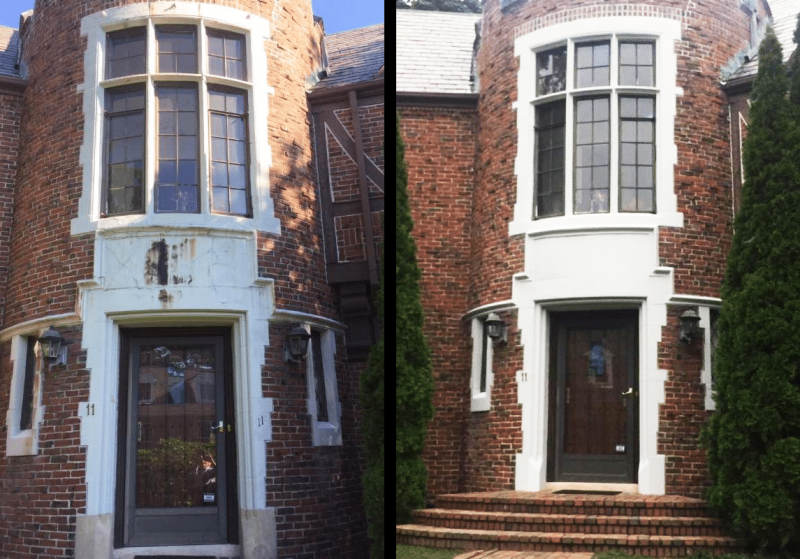

Common defects in concrete include voids and inclusions due to improper consolidation, poor surface finish or cracked surface due to plastic shrinkage, damage and cracking from residual stresses due to thermal effects, surface weakness, weak bonds between steel and concrete due to bleeding, cold joints, etc.
 Concrete deterioration over time could be load related — such as fatigue, impact, residual stresses due to overloading and creep — or environmentally-related, such as corrosion, chemical attack, alkali-silica reaction, creep and shrinkage, carbonation, freezing and thawing, or salt scaling. Improper maintenance or repair could also classify as a service-induced damage.
We often use “sound testing” to help determine the defective areas in the concrete walls. Sound testing is a simple, non-destructive test typically accomplished with a hammer or steel rod. Simply stated, sound testing involves striking the concrete surface and interpreting the sound produced. Solid concrete will produce a ringing sound, while spalled, delaminated, or voided concrete will produce a flat or hollow sound. Sound testing is best suited for flat surfaces, vertical or horizontal, where large areas can be tested in a reasonable amount of time.